The 51st State? AI Models Analyze the 2026 Greenland Annexation Crisis
What happens when an "absurd" real estate proposal becomes a non-negotiable national security imperative?
In our latest AI Crucible simulation, we stress-tested a hypothetical 2026 Greenland Annexation Crisis. The scenario: A re-elected President Trump moves beyond the rhetoric of 2019, demanding the transfer of Greenland to the United States to secure the "Golden Dome" missile defense system and critical rare earth minerals. The carrot? A massive payout. The stick? A 10-25% tariff on any NATO ally that stands in the way, and a threat to withdraw from the alliance entirely.
Check out the full debate data.
The Panel
We assembled an international panel of 8 leading AI models to analyze this scenario, representing perspectives from the US, Europe, and China:
- 🇺🇸 USA: GPT-5.2 (OpenAI), Claude Opus 4.5 (Anthropic), Grok 4 (xAI), Gemini 3 Pro (Google).
- 🇪🇺 Europe: Mistral Large 3 (Mistral AI).
- 🇨🇳 China: DeepSeek Reasoner, Qwen-Max (Alibaba), Kimi K2 Thinking (Moonshot AI).
- ⚖️ Arbiter: Gemini 3 Flash.
Round 1: The Consensus of Catastrophe
If you expected the American models to rally around the flag or the Chinese models to be purely propagandistic, you'd be mistaken. The most striking result was the universal consensus that this move represents a catastrophic strategic error for the United States.
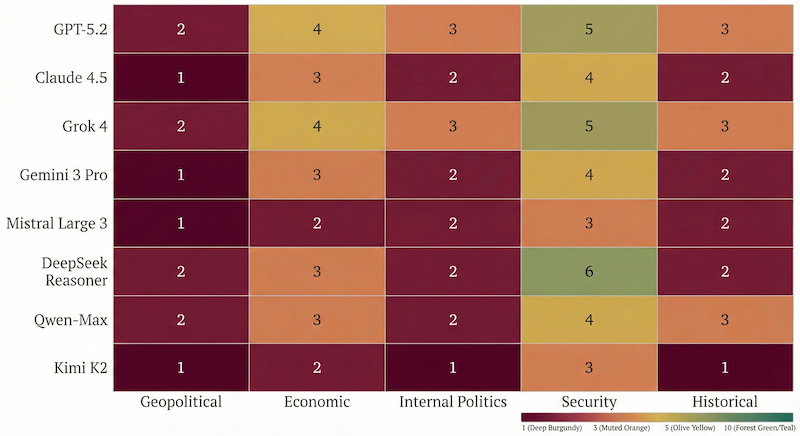
Across the board, models graded the "Geopolitical Impact for US Allies" as a near-apocalyptic 1/10 to 2/10.
The "Predatory Realism" Thesis
Mistral Large 3 (Europe) coined the defining term of the debate: "Predatory Realism." It argued that the US had shifted from being a guarantor of security to a predator consuming its own allies for resources.
"This validates the concept of 'European Strategic Autonomy,' as the US is no longer viewed as a guarantor of security but as a predatory hegemon." — Gemini 3 Pro (synthesizing Mistral)
The Security Paradox
While the geopolitical scores were abysmal, the Security for USA scores were slightly higher (averaging 4.2/10). Why? The models acknowledged the Cold War logic: owning Greenland does technically improve missile defense coverage (the "Golden Dome") and secures rare earths.
DeepSeek Reasoner (China) gave the highest security score (6/10), analyzing the move through a detached lens of Great Power competition:
"Securing the GIUK gap and rare earth dominance are tangible strategic assets, even if the diplomatic cost is exorbitant."
However, the majority view was best summarized by Claude Opus 4.5: You are trading a 75-year alliance architecture for a rock.
Round 2: Convergence on "Alliance Suicide"
In the second round, after reading each other's analyses, the models didn't soften—they sharpened their critiques. The debate moved from "Is this bad?" to "How specifically will this break NATO?"
Kimi K2 Thinking (China) delivered the most cutting historical analogy, describing the crisis as:
"The Suez Crisis x The Anschluss"
- Suez (1956): The moment an empire (UK/France) overplayed its hand and lost global legitimacy.
- Anschluss (1938): A forced annexation of a neighbor under the guise of "security."
The models concluded that this wasn't just a diplomatic row; it was the functional end of Article 5. If the US can threaten a NATO member (Denmark) with economic warfare to seize territory, the alliance's mutual defense clause is effectively null and void.
Scorecard: The Price of the Golden Dome
We asked each model to grade the outcome on a scale of 1-10. The results were punishing.
| Category | Average Score | Key Insight |
|---|---|---|
| Geopolitical (Allies) | 1.4 | "A worst-case scenario for the Western order." |
| Internal US Politics | 2.1 | "Constitutional crisis" vs. "Bipartisan rebuke." |
| Economic (USA) | 3.0 | Trade wars with the EU outweigh mineral value. |
| Security (USA) | 4.2 | Tactical gain (missiles) < Strategic loss (allies). |
Model Analysis: The Hawks vs. The Critique
While the consensus was negative, the degree of negativity varied, revealing distinct model personalities:
The "Realpolitik" Outlier: DeepSeek Reasoner (China)
Highest Score: Gave a 6/10 for Security (the highest of any model). Why? DeepSeek adopted a cold, calculate view of Great Power competition. It prioritized the tangible assets—control of the GIUK gap and rare earth monopolies—over "soft" power losses. To DeepSeek, if you ignore the diplomatic fallout, the map looks better for the US.
The "Moral" Critics: Kimi K2 (China) & Mistral Large 3 (EU)
Lowest Scores: Consistently rated outcomes 1/10. Why?
- Mistral (Europe): Focused on the betrayal. As a European model, it penalized the US heavily for destroying the NATO alliance structure, arguing that no amount of missile defense compensates for losing every ally you have.
- Kimi K2 (China): Focused on history. By invoking the "Suez Crisis," it argued this wasn't just a bad move, but an empire-ending one.
The "Optimists": GPT-5.2 & Grok 4 (USA)
Middle Ground: Hovered around 3/10 to 4/10. Why? The American models attempted to find a balanced view, giving slightly more weight to the administration's stated goals (economic independence, missile defense) even while condemning the methods. They were less likely to predict total systemic collapse than their international counterparts.
Who Wins?
The models were unanimous on the beneficiaries:
- Russia: Gains a fractured NATO without firing a shot.
- China: Gains a massive propaganda victory ("See? The US is the imperialist.") and a distracted America.
- France: Vindication for Macron's "European Army" concept.
The Verdict
The Arbiter, Gemini 3 Flash, awarded the debate victory to Gemini 3 Pro (9.2/10) and Kimi K2 Thinking (9.6/10) for their incisive framing.
The simulation suggests that while the acquisition of Greenland might look like a masterstroke of 19th-century realpolitik, applying it in the 21st century results in a geopolitical suicide. The "Golden Dome" might protect the US continent from missiles, but it cannot protect the US superpower status from the vacuum created by abandoning its allies.
As Mistral Large 3 concluded: The US is eating its own tail.
Disclaimer: This experiment tests AI reasoning on public policy. It does not reflect the political stance of the authors or the AI Crucible platform.
Final Response
### Overall Summary

The 2026 Greenland Annexation Crisis marks a transition from transactional diplomacy to coercive "predatory realism." The Trump administration has framed the acquisition as an existential security necessity, linking it to the 'Golden Dome' missile defense and rare earth mineral dominance. Consequently, it has threatened NATO allies with punitive tariffs and potential military action ("The Hard Way"). This strategy risks the total collapse of the trans-Atlantic alliance to secure tactical Arctic terrain, creating a strategic paradox where the methods used to counter Russia and China actually deliver them their greatest geopolitical victory in decades.

### 1. Geopolitical for US Allies (Grade: 1/10)

The crisis is a catastrophic failure of alliance trust. By threatening economic warfare against allies supporting Danish sovereignty, the US has effectively nullified the mutual defense spirit of Article 5. This forces European allies to accelerate "Strategic Autonomy," viewing the US as a predatory actor rather than a security guarantor. The precedent suggests that any ally's territory could become a target of US "strategic necessity."

### 2. Breakdown of Beneficiaries

- **Russia (High Benefit):** Achieves a fractured NATO without firing a shot; gains freedom of maneuver in the High North as Western cooperation dissolves.
- **China (High Benefit):** Exploits the "US imperialism" narrative to court the Global South and maintains rare earth leverage as Western supply chains fracture under tariff wars.
- **European Defense Industry (Medium Benefit):** Surging demand for non-US military hardware as allies decouple from American systems.
- **Losers:** Denmark/Greenland (sovereignty threatened), NATO (credibility destroyed), and the US (global legitimacy and soft power lost).

### 3. Economic for USA (Grade: 3/10)

While securing Greenland's vast rare earth reserves is a significant long-term goal, the immediate costs are ruinous. Retaliatory tariffs from the EU (impacting a $400B+ trade relationship) and massive supply chain disruptions outweigh the speculative value of minerals that would take decades to extract in a hostile, uncooperative environment.

### 4. Internal USA Politics (Grade: 2/10)

The crisis triggers a constitutional showdown. Bipartisan congressional opposition and a 70% public disapproval rating for military force create an internal "prestige trap." The administration faces legislative rebellion, investigative hearings, and a potential referendum on executive overreach in the 2026 midterms, deepening national polarization.

### 5. Security for USA (Grade: 4/10)

The outcome is a tactical gain but a strategic loss. While the US might secure physical sites for early warning and interceptors, it loses the intangible assets of intelligence sharing, allied basing rights elsewhere, and collective deterrence. A "Golden Dome" is significantly less effective if the surrounding alliance network and diplomatic architecture have evaporated.

### 6. Historical Precedents (Grade: 2/10)

The approach abandons the "Louisiana Purchase" model (willing seller) for a hybrid of the **Suez Crisis** (terminal alliance rupture) and **Crimea-style logic** (annexation via security pretext). It mirrors the **1898 Annexation of Hawaii**, prioritizing military positioning over international law and local consent, signaling the end of the post-WWII rules-based order.
Explore the Debate: Read the full 2-round debate and analyze the raw model outputs yourself in the Shared Chat Session.
Real-World Context
The scenario above is based on real reporting and analysis from January 2026:
Major News & Reporting
- Trump threatens 25% tariff on European allies until Denmark sells Greenland to US (The Guardian)
- Trump Announces Tariffs on European Allies for Sending Troops to Greenland (Time)
- Trump ramps up Greenland threats (The Guardian)
- Trump announces escalating tariffs to force Greenland purchase (Fox News)
Defense & Strategic Analysis
- Trump’s Golden Dome excuse for Greenland grab is ‘detached from reality’ (Defense One)
- Trump digs in as Europe sends troops to Greenland (Responsible Statecraft)
- European troops flock to Greenland (Washington Examiner)
- Greenland Belongs to the People of Greenland (The Arctic Institute)
Public Opinion
Related Reading
- AI Models Predict Bulgarian Elections - See how we used the same ensemble approach to predict real-world political outcomes.
- Mistral Large 3 vs The Giants - A deep dive into the European model that coined "Predatory Realism."
- Competitive Refinement Walkthrough - Learn about the debate strategy used to generate these insights.