GPT-5.6 Sol vs Claude Opus 4.8: A Reasoning Head-to-Head
OpenAI's GPT-5.6 Sol is now available in AI Crucible. It is the new flagship of the "Sol" tier, built for complex professional work. It ships with a 1M-token context window and strong step-by-step reasoning.
So we put it straight into the ring against Anthropic's flagship, Claude Opus 4.8. We picked a task that rewards careful logic, not memorized trivia. The result was closer than a single leaderboard number would suggest.
How did we run the comparison?
We used the Competitive Refinement strategy with both models in the panel. A neutral third model, Gemini 3 Flash, acted as the arbiter. This keeps the scoring away from either contestant's home team.
The prompt was the classic twelve-coin puzzle:
You have 12 identical-looking coins. Exactly one is counterfeit and differs in weight, but you do not know whether it is heavier or lighter. Using a balance scale at most 3 times, identify the counterfeit coin and whether it is heavy or light. Prove that your strategy handles every possible case.
This problem is a clean reasoning test. There are 24 possible states and only 27 outcome sequences across three weighings. A model must build a decision tree with almost no slack. A hand-wavy answer collapses under the case analysis.
Did both models solve the puzzle?
Yes. Both models produced a correct, complete, and provably exhaustive strategy.
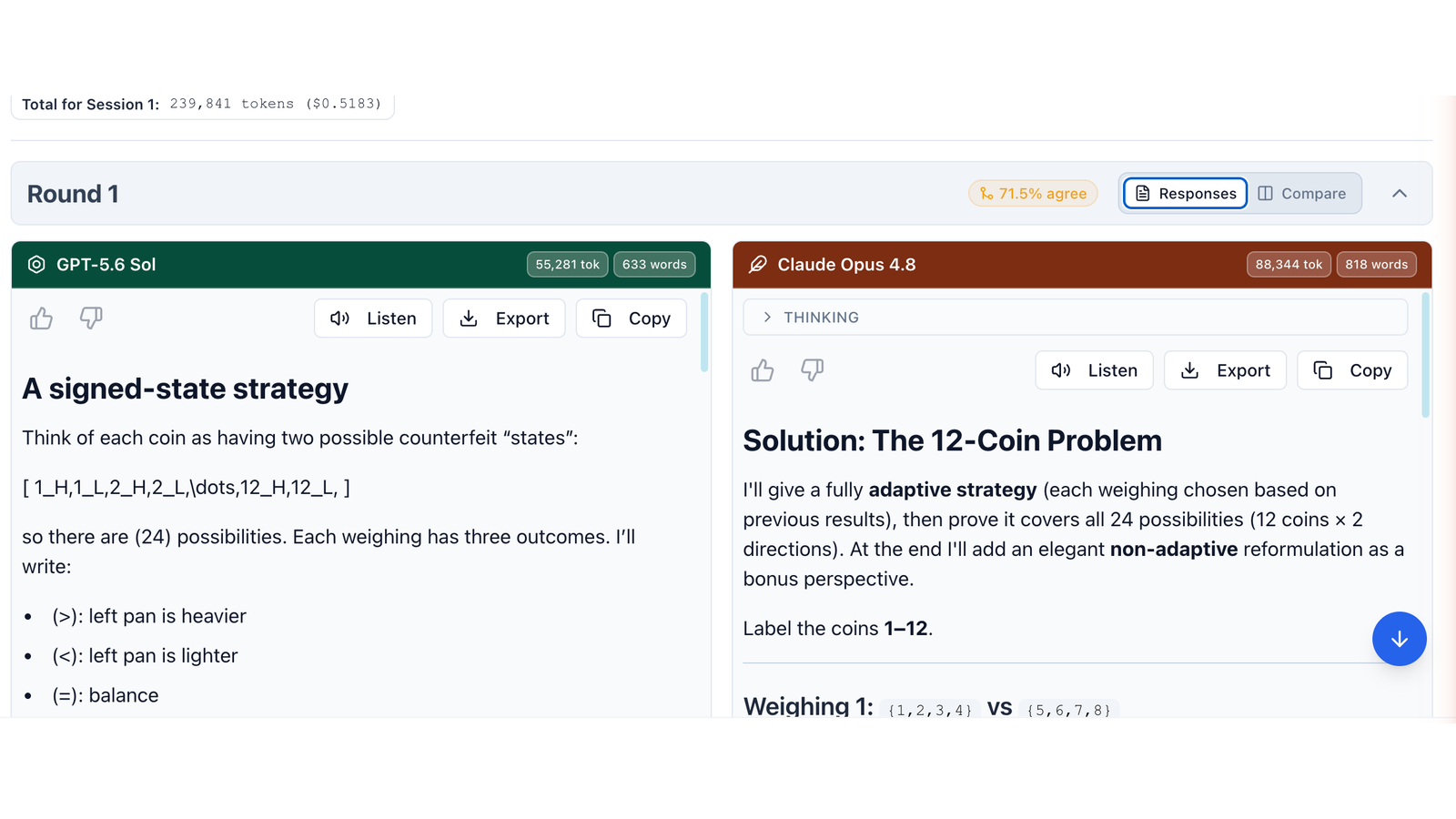
GPT-5.6 Sol opened with a "signed-state" framing. It treated each coin as two possible states, heavy or light, for 24 cases total. It then split them with the first weighing of coins 1-4 against 5-8. Its case analysis was tight and its completeness argument was explicit.
Claude Opus 4.8 chose the same opening weighing but framed it as a fully adaptive strategy. It walked through Case A, Case B, and Case C with a running checkmark after each resolved branch. It then added a bonus non-adaptive reformulation as an extra perspective.
Both proofs were valid. Neither left a case ambiguous.
How similar were the two answers?
AI Crucible measured 71% similarity between the two responses. That number matches what we saw by eye. Both models reached for the same first weighing and the same three-way branch structure.
This convergence is itself a useful signal. When two independent frontier models agree on the method, confidence in the answer rises. That agreement metric is a core reason to run models as an ensemble rather than alone.
Which model was faster and tighter?
This is where the two flagships parted ways.
| Model | Time | Words | Output tokens |
|---|---|---|---|
| GPT-5.6 Sol | 11.3s | 633 | 3,037 |
| Claude Opus 4.8 | 42.4s | 818 | 3,982 |
GPT-5.6 Sol was about four times faster and noticeably more concise. It stated the strategy, proved it, and stopped.
Claude Opus 4.8 took longer and wrote more. The extra length was not padding. It read like a patient tutor, with narrated branches and a bonus reformulation. That style has real value when you want to learn the method, not just get the answer.
What does this mean for picking a reasoning model?
Both models are genuinely strong reasoners. On this proof, correctness was a tie. The choice comes down to what you value.
- Choose GPT-5.6 Sol when you want a correct answer fast, in as few tokens as possible.
- Choose Claude Opus 4.8 when you want depth, teaching, and alternative framings.
The larger lesson is about method. One model can be confident and wrong. Two models that agree, scored by a neutral third, give you a signal you cannot get from a solo run. That is the case for orchestration.
Want to run your own head-to-head? Add GPT-5.6 Sol and Claude Opus 4.8 to a panel in AI Crucible and pick a problem that matters to you.