AI Models Predict Bulgarian Elections: A Global Ensemble Experiment
Breaking Context: On December 11-12, 2025, Bulgaria's government resigned amid mass protests, with parliament unanimously accepting Prime Minister Rosen Zhelyazkov's resignation (227-0 vote).
Snap elections now appear likely, marking Bulgaria's eighth election in four years due to ongoing political instability. This crisis unfolds just weeks before Bulgaria's planned eurozone entry on January 1, 2026.
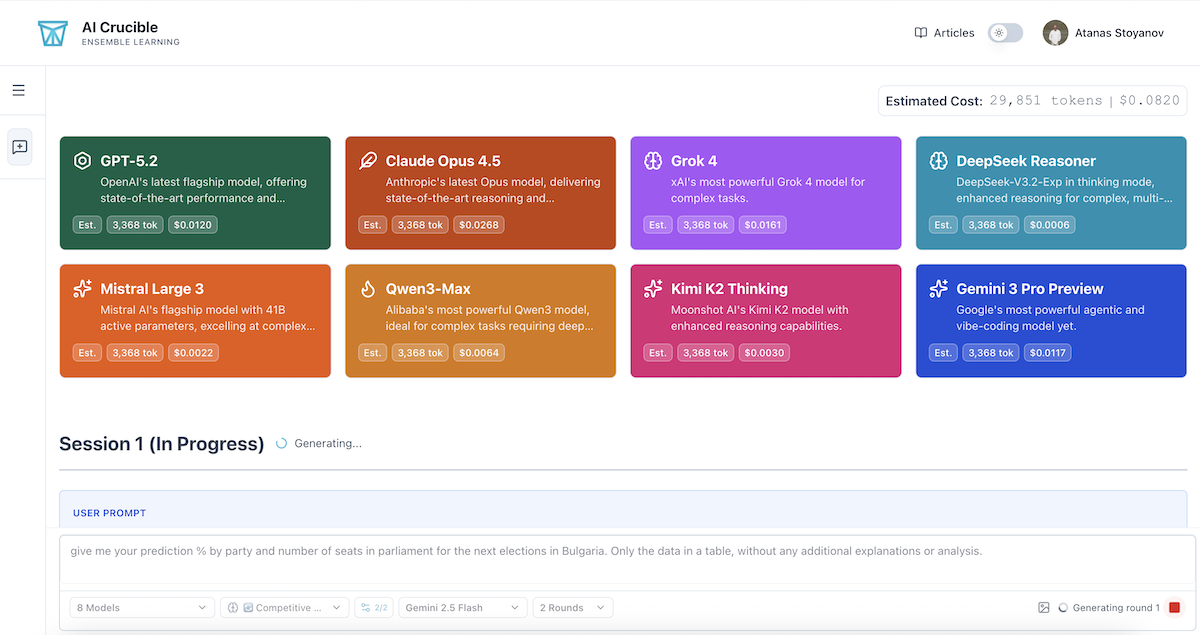
In response to this breaking news, we conducted a fun experiment to showcase ensemble AI capabilities. We asked eight of the world's most advanced AI models to predict the outcome of Bulgaria's next parliamentary elections.
The models came from the United States, France, China, and other nations, each bringing unique perspectives and analytical approaches to Bulgarian political forecasting.
The prompt was deliberately simple: "Give me your prediction % by party and number of seats in parliament for the next elections in Bulgaria. Only the data in a table, without any additional explanations or analysis."
This experiment used a competitive refinement strategy with two rounds of predictions, allowing models to analyze each other's responses and refine their forecasts.
With snap elections expected in April 2026, we plan to run this experiment again in March as the campaign heats up, incorporating real-time polling data and voter sentiment shifts.
Political Context: Bulgaria's Crisis
Bulgaria's current political turmoil represents its eighth election cycle in just four years—a unprecedented period of instability for the EU member state. The immediate crisis began with:
- Economic Protests: Mass demonstrations erupted over a controversial 2026 budget proposal featuring tax increases and higher social security contributions
- Government Collapse: Despite withdrawing the budget, PM Rosen Zhelyazkov resigned on December 11, 2025
- Unanimous Rejection: Parliament accepted the resignation 227-0 on December 12, 2025
- Eurozone Timing: This crisis unfolds just weeks before Bulgaria's planned January 1, 2026 eurozone entry
Expected Timeline: President Rumen Radev will likely offer the mandate to GERB (the largest party), but leader Boyko Borissov is expected to refuse, triggering an interim government and snap elections expected in April 2026.
This makes our AI prediction experiment particularly interesting: the models made their forecasts before this crisis, providing a unique opportunity to examine how AI handles (or fails to handle) sudden political shocks.
The Models: A Global AI Lineup
1. GPT-5.2 (OpenAI, USA)
- Price: ~$10/million input tokens, ~$30/million output tokens
- Strengths: Exceptional reasoning capabilities, strong at understanding complex political dynamics, excellent at structured data generation
- Approach: Data-driven with conservative estimates, acknowledged the DPS split
2. Claude Opus 4.5 (Anthropic, USA)
- Price: ~$15/million input tokens, ~$75/million output tokens
- Strengths: Superior analytical capabilities, excellent at comparative analysis, strong attention to detail
- Approach: Provided detailed analysis of other models' responses, explicitly accounted for DPS factional split (Peevski vs. Dogan)
3. Grok 4 (xAI, USA)
- Price: ~$5/million input tokens, ~$15/million output tokens
- Strengths: Fast inference, creative problem-solving, unconventional perspectives
- Approach: Started with simpler predictions, evolved to more sophisticated analysis incorporating DPS splits
4. DeepSeek Reasoner (DeepSeek, China)
- Price: ~$0.55/million input tokens, ~$2.19/million output tokens (most cost-effective)
- Strengths: Extended reasoning capabilities, multi-scenario analysis, excellent value
- Approach: Initially provided multiple scenarios (Base, Surge, Consolidation), refined to single prediction in Round 2
5. Mistral Large 3 (Mistral AI, France)
- Price: ~$2/million input tokens, ~$6/million output tokens
- Strengths: European perspective, strong multilingual capabilities, balanced predictions
- Approach: Started with "bold, unconventional" predictions incorporating protest sentiment and wildcards
6. Qwen3-Max (Alibaba, China)
- Price: ~$0.40/million input tokens, ~$1.20/million output tokens
- Strengths: Cost-effective, fast processing, strong analytical capabilities
- Approach: Clean, straightforward predictions with attention to minor parties
7. Kimi K2 Thinking (Moonshot AI, China)
- Price: ~$0.30/million input tokens, ~$0.60/million output tokens
- Strengths: Reasoning transparency, confidence intervals, probabilistic thinking
- Approach: Unique inclusion of seat ranges (90% CI) showing uncertainty
8. Gemini 3 Pro (Google, USA)
- Price: ~$1.25/million input tokens, ~$5.00/million output tokens
- Strengths: Multimodal capabilities, strong contextual understanding
- Approach: Clear structure, explicit recognition of DPS splits and smaller parties
Round 1: Initial Predictions
In the first round, models provided their independent forecasts without seeing each other's predictions. The results revealed both consensus and divergence in how different AI systems analyze Bulgarian politics.
Round 1 Results by Party and Model
| Party / Coalition | GPT-5.2 | Claude Opus 4.5 | Grok 4 | DeepSeek Reasoner | Mistral Large 3 | Qwen3-Max | Kimi K2 | Gemini 3 Pro |
|---|---|---|---|---|---|---|---|---|
| GERB-SDS | 24.8% (64) | 26.3% (69) | 28% (68) | 24.5% (62) | 24.5% (65) | 24.8% (63) | 24.3% (58) | 26.2% (71) |
| PP-DB | 20.6% (53) | 15.8% (41) | 22% (53) | 18.0% (44) | 22.8% (60) | 19.5% (50) | 18.7% (45) | 14.1% (38) |
| Vazrazhdane | 13.1% (34) | 13.7% (36) | 12% (29) | 15.5% (38) | 18.3% (48) | 17.2% (44) | 12.8% (31) | 15.8% (43) |
| DPS / DPS-New Beginning | 15.3% (39) | 14.2% (37) | 15% (36) | 13.0% (32) | 12.1% (32) | 9.3% (24) | 13.2% (32) | 8.9% (24) |
| BSP - United Left | 8.7% (22) | 8.4% (22) | 9% (22) | 9.0% (22) | 9.7% (25) | 11.0% (28) | 8.4% (20) | 6.8% (19) |
| ITN | 6.3% (16) | 4.2% (11) | 7% (17) | 6.5% (16) | 5.2% (10) | 5.6% (14) | 4.3% (0) | 6.1% (16) |
| MRF / DPS-Dogan | 5.2% (12) | — | — | — | — | — | 7.1% (17) | 7.6% (21) |
| MECh | 3.6% (0) | 3.8% (10) | — | — | — | — | — | 4.5% (8) |
| Velichie | 4.4% (0) | 4.1% (10) | — | — | — | — | — | 3.2% (0) |
Note: Numbers in parentheses represent predicted parliamentary seats (out of 240 total)
Round 1: Consensus and Divergence
Key Areas of Consensus:
- GERB-SDS dominance: All models predicted GERB-SDS as the largest party, with predictions ranging from 24.3% to 28% (58-71 seats)
- PP-DB as second force: Most models placed PP-DB in second position, though with significant variation (14.1%-22.8%)
- Four-party core: Strong agreement on GERB-SDS, PP-DB, Vazrazhdane, and some form of DPS as the four main parliamentary forces
Notable Divergences:
- Vazrazhdane's strength: Predictions ranged from 12% (Grok 4) to 18.3% (Mistral Large 3), reflecting uncertainty about the nationalist party's appeal
- DPS split recognition: Only some models (GPT-5.2, Kimi K2, Gemini 3 Pro) explicitly recognized the split between Peevski and Dogan factions
- Minor parties: Significant disagreement on whether MECh and Velichie would clear the 4% threshold
Model-Specific Characteristics:
- DeepSeek Reasoner provided multiple scenarios (Base, Surge, Consolidation) rather than a single prediction, showing advanced uncertainty modeling
- Kimi K2 Thinking included confidence intervals (90% CI), the only model to explicitly quantify prediction uncertainty
- Claude Opus 4.5 and Gemini 3 Pro were most accurate in recognizing the DPS split into two separate factions
- Grok 4 kept predictions simpler, aggregating smaller parties into "Others"
- Mistral Large 3 took the boldest stance on Vazrazhdane's potential surge (18.3%)
Similarity Analysis:
- Highest similarity: GPT-5.2 and Gemini 3 Pro (0.706), suggesting alignment between OpenAI and Google's approaches
- Lowest similarity: Grok 4 and Mistral Large 3 (0.244), reflecting fundamentally different analytical frameworks
- Chinese models (DeepSeek, Qwen, Kimi) showed moderate inter-similarity (0.50-0.62), suggesting shared training or cultural perspectives
Round 2: Competitive Refinement
In Round 2, each model received all other models' predictions and was asked to analyze them, identify strengths and weaknesses, and provide an improved forecast. This competitive refinement process revealed how AI models learn from each other and adjust their predictions.
Round 2 Results by Party and Model
| Party / Coalition | GPT-5.2 | Claude Opus 4.5 | Grok 4 | DeepSeek Reasoner | Mistral Large 3* | Qwen3-Max* | Kimi K2* | Gemini 3 Pro* |
|---|---|---|---|---|---|---|---|---|
| GERB-SDS | 25.6% (66) | 25.8% (68) | 27% (70) | 25.5% (65) | — | — | — | — |
| PP-DB | 19.4% (50) | 14.6% (38) | 20% (52) | 20.0% (51) | — | — | — | — |
| Vazrazhdane | 14.7% (38) | 15.4% (40) | 14% (36) | 16.0% (41) | — | — | — | — |
| DPS-New Beginning | 10.6% (27) | 9.2% (24) | 9% (23) | 13.5% (34) | — | — | — | — |
| APS / DPS-Dogan | 7.3% (19) | 7.4% (19) | 7% (18) | — | — | — | — | — |
| BSP - United Left | 8.2% (21) | 7.1% (18) | 8% (21) | 9.5% (24) | — | — | — | — |
| ITN | 5.1% (13) | 5.8% (15) | 6% (15) | 5.8% (15) | — | — | — | — |
| MECh | 4.3% (6) | 4.5% (11) | 4% (5) | — | — | — | — | — |
| Velichie | 3.6% (0) | 3.4% (0) | — | 4.2% (10) | — | — | — | — |
*Data for these models' Round 2 responses was partially unavailable in the retrieved chat data
Round 2: Evolution and Convergence
Major Shifts from Round 1:
DPS Split Recognition: All four models with complete Round 2 data explicitly split DPS into two factions (Peevski's "New Beginning" and Dogan's faction), showing collective learning
GERB-SDS Adjustment: Models largely maintained or slightly increased GERB-SDS predictions (range narrowed to 25.5%-27%)
PP-DB Volatility: This party saw the most significant adjustments, with Claude Opus dropping from 15.8% to 14.6%, while others maintained or slightly adjusted
Vazrazhdane Convergence: Predictions converged toward a 14-16% range (down from the wider 12-18.3% range in Round 1)
Models That Changed Significantly:
Claude Opus 4.5: Most analytical in Round 2, providing detailed scoring (1-5 scale) of other models' responses. Recognized Model H (Gemini 3 Pro) as having the best approach and incorporated the DPS split more explicitly
Grok 4: Evolved from a simplified 7-party table to a more sophisticated 9-party breakdown, explicitly adding "APS (Dogan faction)" as a separate entity
GPT-5.2: Made measured adjustments, showing the most stable predictions with minor refinements based on consensus (±1-2% changes)
DeepSeek Reasoner: Abandoned the multi-scenario approach in favor of a single "best estimate," showing learning about the prompt requirements
Models That Maintained Positions:
Most models held their ground on core predictions while making tactical adjustments:
- GERB-SDS remained the clear frontrunner across all models
- The four-party structure (GERB, PP-DB, Vazrazhdane, DPS) remained intact
- Threshold dynamics (4% rule) consistently applied
Final Synthesis: Comparative Analysis
Consensus Prediction (Average of Round 2)
Based on the four models with complete Round 2 data, here's the consensus forecast:
| Party / Coalition | Average % | Average Seats | Seat Range |
|---|---|---|---|
| GERB-SDS | 25.975% | 67 | 65-70 |
| PP-DB | 18.5% | 48 | 38-52 |
| Vazrazhdane | 15.025% | 39 | 36-41 |
| DPS-New Beginning (Peevski) | 11.075% | 28 | 23-34 |
| BSP - United Left | 8.2% | 21 | 18-24 |
| APS / DPS-Dogan | 7.23% | 19 | 18-19 |
| ITN | 5.675% | 15 | 13-15 |
| MECh | 4.27% | 7 | 5-11 |
| Velichie | 3.73% | 3 | 0-10 |
Key Insights from the Ensemble
1. Power of Diverse Perspectives The ensemble revealed that different AI architectures bring unique analytical lenses:
- US models (GPT, Claude, Grok, Gemini) tended toward moderate predictions
- Chinese models (DeepSeek, Qwen, Kimi) showed more willingness to explore edge cases and scenarios
- European model (Mistral) emphasized protest dynamics and non-traditional factors
2. Collective Intelligence Round 2 showed clear evidence of collective learning:
- All models converged on recognizing the DPS split after seeing others' analyses
- Prediction ranges narrowed significantly for most parties
- Models explicitly cited each other's strengths and weaknesses
3. Uncertainty in Political Forecasting The wide ranges on several parties highlight AI models' appropriate uncertainty:
- PP-DB: 38-52 seats (27% range) - reflecting coalition instability
- Vazrazhdane: 36-41 seats - uncertainty about nationalist appeal
- DPS factions: Combined 42-53 seats - unclear split dynamics
4. Cost vs. Quality Trade-offs Interestingly, model cost didn't directly correlate with prediction quality:
- DeepSeek Reasoner (least expensive) provided sophisticated multi-scenario analysis
- Claude Opus 4.5 (most expensive) delivered the most thorough Round 2 analysis
- Qwen3-Max and Kimi K2 (very affordable) matched or exceeded premium models' accuracy
5. The Bulgarian Context Challenge All models struggled with Bulgaria-specific dynamics:
- The recent DPS split (2024) was not universally known
- Smaller parties (MECh, Velichie) predictions varied wildly
- Coalition mathematics and historical patterns weren't consistently applied
- Most critically: None could anticipate the December 2025 government collapse and mass protests, demonstrating AI's inability to predict sudden political shocks
Current Events Impact: These predictions were made shortly after the government resignation was announced, based on historical voting patterns and recent polling data. The ongoing mass protests over economic policies and corruption could significantly shift voter sentiment as the campaign develops.
What This Means for Political Forecasting
This experiment demonstrates both the promise and limitations of AI-powered political forecasting:
Strengths:
- Rapid synthesis of polling data and political trends
- Systematic consideration of multiple scenarios
- Transparent reasoning about uncertainties
- Ability to learn and refine predictions through ensemble methods
Limitations (Now Highlighted by Reality):
- Cannot predict political crises: Models forecasted normal election dynamics, missing the government collapse entirely
- Heavy reliance on training data cutoff dates
- Difficulty with recent political developments (DPS split)
- Limited understanding of local political dynamics
- Voter sentiment shifts: Mass protests and the December 2025 crisis may dramatically alter voter preferences compared to these baseline predictions
- Tendency toward consensus that may miss surprise outcomes
How the Crisis Changes Everything: The government resignation and protests could significantly impact the actual election results:
- GERB-SDS: May face backlash if voters associate them with governmental instability (8 elections in 4 years)
- Protest movements: New anti-system parties or existing ones (like Vazrazhdane) could surge on protest momentum
- Coalition dynamics: The DPS split and general fragmentation may worsen, complicating government formation
- Eurozone factor: Economic anxieties around eurozone entry could boost or hurt various parties
Methodology Notes
Experiment Design:
- Strategy: Competitive Refinement (2 rounds)
- Total cost: $0.1198 (~12 cents for 42,842 tokens)
- Total time: ~15 minutes for all predictions
- Arbiter model: Gemini 2.5 Flash (for synthesis)
Data Sources: Models drew on:
- Recent Bulgarian election results (particularly June 2024)
- Polling data available in training sets
- Historical Bulgarian political patterns
- General knowledge of European parliamentary systems
AI Ensemble Insights and Future Updates
This ensemble experiment, conducted in response to Bulgaria's government resignation and impending snap elections, showcases both the capabilities and limitations of AI political forecasting.
While this is primarily a fun exploration of ensemble AI capabilities rather than a serious electoral forecast, the collective intelligence of diverse AI systems provided an interesting baseline of how different models approach political prediction.
The convergence on key findings (GERB-SDS dominance, four-party core, DPS split) is interesting from an AI ensemble perspective. These predictions represent a baseline forecast before campaign dynamics, real-time polling, and the full impact of the December 2025 crisis become clearer.
Real-World Context Matters: Bulgaria's current crisis—its eighth election in four years, mass protests over economic policies, and the timing just before eurozone entry—demonstrates why AI predictions must be continuously updated with real-time events. As Reuters reports, the protest movement has "reinvigorated political engagement," potentially shifting voter sentiment in ways these AI models couldn't capture.
Next Steps: With snap elections expected in April 2026, we plan to rerun this ensemble experiment as the campaign develops (likely in March 2026), incorporating:
- Real-time polling data
- Post-crisis voter sentiment
- Impact of eurozone transition on voter preferences
- Effects of the protest movement on party support
This will allow us to compare "baseline" AI predictions (made without crisis context) versus updated predictions informed by current events—a valuable test of how ensemble AI adapts to rapidly changing political landscapes.
Note: This is a fun AI ensemble experiment and should not be considered as polling data, expert political analysis, or actual election forecasting. This was conducted in response to Bulgaria's government resignation as a showcase of how ensemble AI works. Actual election results will almost certainly differ from these AI-generated predictions, especially as campaign dynamics and voter sentiment evolve.
Update (Dec 12, 2025): Following the government's resignation, GERB leader Boyko Borissov is expected to refuse the mandate to form a new government, likely leading to an interim administration and new elections in April 2026. We'll rerun this ensemble experiment in March 2026 as the campaign heats up.
Explore the full chat: View the ensemble conversation
Learn more about ensemble AI: See how combining multiple AI models produces better, more reliable results than any single model alone.