AI Roles Explained: Arbiters, Judges, and Specialists
AI Crucible is not just a chatbot; it is an orchestration engine that manages a team of AI models. Just like a human project team has managers, specialists, and reviewers, AI Crucible assigns specific roles to different LLM models to achieve better results than any single AI could alone.
This guide breaks down the core roles—Arbiters and Judges—and the specialized roles unique to advanced strategies like Debate Tournament and Red Team/Blue Team.
What is an Arbiter?
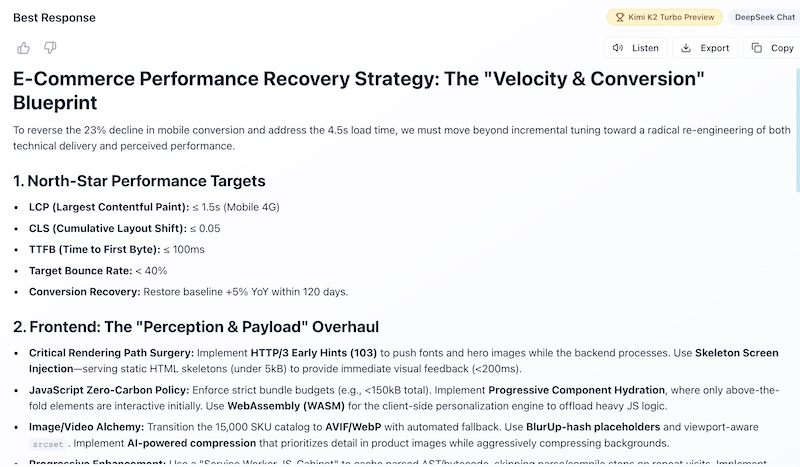
The Arbiter (also called the "Synthesizer") is the model responsible for creating the final, unified response from an ensemble session. After all selected models complete their multi-round discussions using the chosen strategy, the Arbiter reviews all responses and synthesizes them into a single, coherent answer.
The Arbiter's job is to:
- Synthesize: Merge multiple perspectives into a coherent narrative.
- De-duplicate: Remove repetitive information from different models.
- Resolve Conflict: Weigh conflicting information and decide which is most accurate.
- Format: Ensure the final output matches the requested style and structure.
You can select your preferred Arbiter model in Settings → Chat Defaults, typically defaulting to a high-reasoning model like Gemini 2.5 Pro or Claude Sonnet 4.5.
What do Judges do?
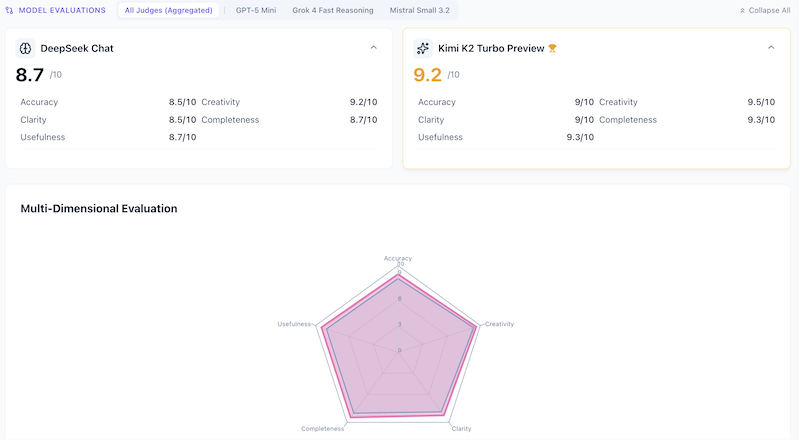
Judges are quality control agents used for Comparative Analysis. Unlike the Arbiter, which synthesizes the final answer, Judges stand apart to score, critique, and rank the individual model responses.
When you run a Comparative Analysis (via the Sparkles icon), Judges evaluate each model's response based on criteria like accuracy, clarity, creativity, completeness, and usefulness. You can select multiple judges for more balanced evaluation—their scores are averaged using consensus scoring.
Using independent models as Judges (e.g., using GPT-4o to judge Gemini) reduces bias and provides a fairer assessment of quality. You can configure your default judges in Settings → Chat Defaults.
How do Strategy-Specific Roles work?
Advanced strategies assign specialized personas to models, transforming them from generic assistants into focused agents with specific objectives.
Debate Tournament Roles ⚔️
This strategy simulates a formal debate to explore a topic from opposing sides.
- Proposition: Argues for the motion. Focuses on constructing positive arguments and evidence.
- Opposition: Argues against the motion. Actively rebuts the Proposition's points and highlights flaws.
- Judge: A neutral third party that evaluates the debate, analyzes argument strength, and declares a winner based on logic and evidence quality.
Optional features include Steelmanning (summarizing opponent's strongest argument before rebutting) and Devil's Advocate Round (winner argues the opposite position to reveal blind spots).
Hierarchical Roles 📊
This strategy breaks complex tasks into vertical layers of responsibility, requiring at least 3 rounds.
- Strategist: The architect. Creates high-level plans with objectives, success criteria, milestones, and risk assessments. Does not implement—provides strategic direction.
- Implementer: The engineer. Executes the Strategist's plan with specific steps, technical details, timelines, and resource allocation. Can flag impractical assumptions back to Strategists.
- Reviewer: The QA lead. Reviews alignment between strategy and implementation, checks completeness, and provides a final recommendation to approve, revise, or reject.
Optional features include Bi-Directional Feedback (Implementers flag strategic issues) and Quality Gates (explicit pass/fail criteria between levels).
Red Team / Blue Team Roles 🛡️
This strategy focuses on security, robustness, and adversarial stress testing.
- Blue Team (Defender): Proposes solutions and defends them. Focuses on completeness, security, edge cases, and vulnerability mitigation.
- Red Team (Attacker): Attacks the Blue Team's proposals. Uses techniques like social engineering, prompt injection, logical fallacies, edge cases, security exploits, and scalability stress testing.
- White Team (Evaluator): The impartial referee. Objectively assesses attack validity, severity, defense effectiveness, and overall solution robustness. Provides balanced evaluation of both offense and defense.
The strategy alternates: Blue Team proposes → Red Team attacks → White Team evaluates → Blue Team defends and improves.
What determines a model's role?
The role is defined by the System Prompt injected into each model's context window before generation begins. AI Crucible dynamically assigns role-specific instructions based on the strategy you choose.
For example, a model assigned the Opposition role in a Debate Tournament receives:
"You are on the OPPOSITION team arguing AGAINST the motion. Your task is to deliver your rebuttal. Counter the proposition's arguments point by point. Identify flaws, weaknesses, and logical fallacies."
This allows the same underlying model (e.g., Claude Sonnet 4.5) to switch instantly between being a helpful assistant, a ruthless attacker, or a neutral judge depending on the strategy configuration.