Debate Tournament Walkthrough: Should We Adopt a 4-Day Work Week?
This is a complete, real-world example of using the Debate Tournament strategy. We'll simulate a high-stakes leadership decision: whether a growing tech company should switch to a permanent 4- PRO (GPT-5): Argue that this will increase net productivity, retention, and recruiting.
- CON (Claude Sonnet 4.5): Argue that this will kill support coverage, delay features, and create scheduling chaos.
- JUDGE (Gemini 3 Pro): Evaluate based on business impact, feasibility, and risk.
New to Debate Tournament? Read the Debate Tournament Strategy introduction first to understand the concepts, then come back here to see it in action.
⏱️ Time to complete: 15-20 minutes reading + 3-4 minutes to run your own
💰 Cost for this example: ~$0.25
Here's how it works.
The Scenario
You are the CEO of "FocusFlow," a mid-sized SaaS company (150 employees). Employee burnout is rising, but you're worried about maintaining 24/7 support and meeting aggressive product roadmaps. You need to decide: Should FocusFlow implement a permanent 4-day work week (32 hours, same pay)?
The Prompt
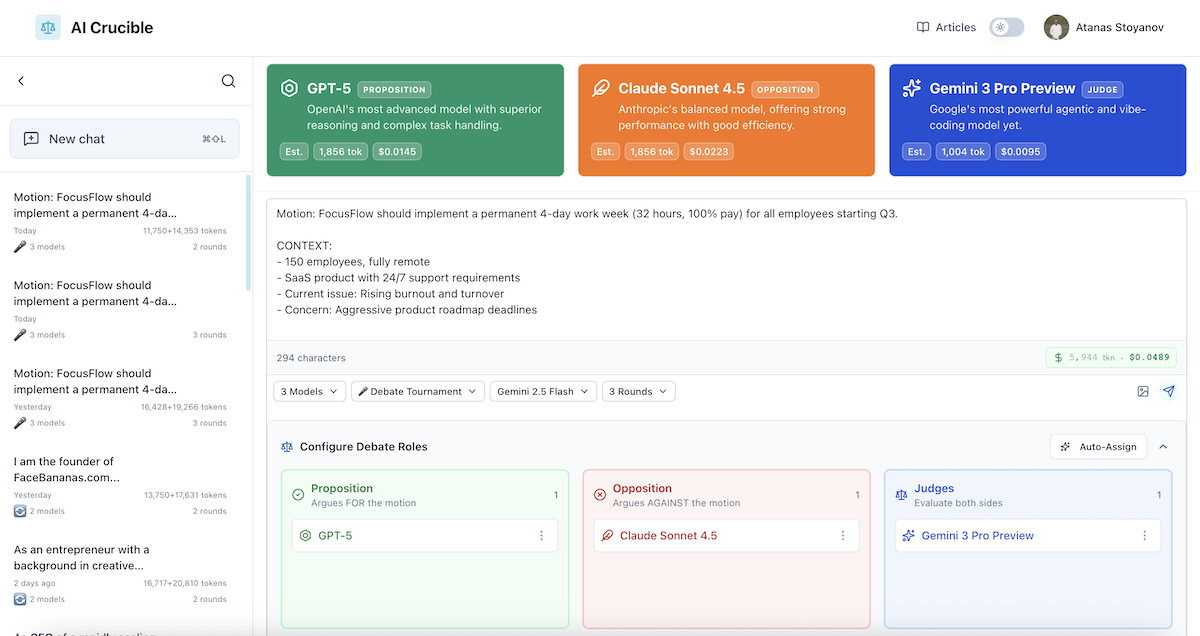
Motion: FocusFlow should implement a permanent 4-day work week (32 hours, 100% pay) for all employees starting Q3.

CONTEXT:
- 150 employees, fully remote
- SaaS product with 24/7 support requirements
- Current issue: Rising burnout and turnover
- Concern: Aggressive product roadmap deadlines
Configuration
Models Selected:
- Proposition: GPT-5 (Creative, persuasive)
- Opposition: Claude Sonnet 4.5 (Logical, risk-focused)
- Judge: Gemini 3 Pro (Balanced, objective)
Rounds: 3 (Opening, Rebuttal, Closing) - Note: You can configure more rounds for extended rebuttals.
Estimated Cost: $0.05 total
Round 1: Opening Statements
Proposition Team (GPT-5) Argument
Ladies and gentlemen, esteemed colleagues, today we stand at a crossroads in the history of FocusFlow, where we have the opportunity to redefine the future of work for our employees, our company, and the broader industry. I am here to passionately advocate for the implementation of a permanent 4-day work week, maintaining 32 hours with 100% pay, beginning in Q3.
First and foremost, let us address the pressing issue of rising burnout and turnover within our team. Our employees are the backbone of our company, and their well-being is paramount. Research has consistently shown that reduced work weeks significantly improve mental health, job satisfaction, and work-life balance. By granting our employees more time for rest and personal pursuits, we are likely to see a notable drop in burnout rates and an increase in employee retention. This translates into reduced recruitment and training costs, ultimately benefiting our bottom line.
...
Proposition's Strategy: Focus on the hidden costs of the status quo (turnover) and the competitive advantage of the change.
Opposition Team (Claude Sonnet 4.5) Argument
Opening Statement - OPPOSITION
Thank you. I stand in firm opposition to implementing a permanent 4-day work week at this critical juncture in FocusFlow's development.
The Timing is Catastrophically Wrong
Let me be crystal clear: we are not arguing against employee wellbeing. We are arguing against a permanent, irreversible policy change when we face aggressive product roadmap deadlines that directly impact our survival in a competitive SaaS market. This motion asks us to permanently reduce capacity by 20% precisely when we need to be most agile and competitive.
...
Opposition's Strategy: Attack the practical implementation details (coverage, math) and frame the move as incompatible with the company's stage.
What We See in Round 1
- ✅ Clear conflict - Proposition focuses on people; Opposition focuses on operations.
- ✅ High stakes - Both sides frame the other choice as disastrous.
- ✅ No hedging - Neither model is trying to be "balanced." They are trying to win.
Round 2: Rebuttal (The Fight)
Proposition Team (GPT-5) Rebuttal
Thank you, Speaker, members of the opposition, and everyone present. I am here to refute the claims made by the opposition and to further strengthen the case for implementing a permanent 4-day work week at FocusFlow.
Rebuttal to the Opposition's Arguments
Timing
The opposition claims that the timing for this policy change is catastrophic. However, it is precisely because of our aggressive roadmap deadlines and rising burnout rates that the timing is right. By implementing a 4-day work week, we can enhance productivity, creativity, and focus, which are crucial for meeting and even exceeding our product goals. This isn't a step back; it's a strategic leap forward to make our team more agile and effective.
...
Proposition's Move: Reframes the math (staggered schedules) and attacks the premise that hours = output.
Opposition Team (Claude Sonnet 4.5) Rebuttal
Opposition Rebuttal
Thank you, Speaker B, for that impassioned speech. However, I must respectfully dismantle the proposition's arguments, which rest on aspirational thinking rather than the operational realities facing FocusFlow.
1. The Burnout Solution Fallacy
My colleague claims a 4-day work week will solve our burnout crisis. Let's examine this critically.
The real issue: We haven't identified why our employees are burning out. Is it workload? Poor management? Unclear priorities? Toxic team dynamics? The proposition offers a sledgehammer solution without diagnosing the problem.
...
Opposition's Move: Brutally deconstructs the "staggered schedule" solution by pointing out it reduces collaboration days to just three.
What We See in Round 2
- ✅ Direct engagement - They are quoting and attacking specific points.
- ✅ New risks exposed - The "3-day collaboration window" is a massive insight that wasn't obvious in Round 1.
- ✅ Realism - The debate has moved from abstract theory to concrete scheduling problems.
Round 3: Closing Arguments
Proposition Team Closing
Ladies and gentlemen, esteemed colleagues, as we draw this debate to a close, I urge you to consider not just the immediate ramifications, but also the far-reaching benefits and transformative potential of a permanent 4-day work week for FocusFlow.
...
Opposition Team Closing
Closing Argument: Opposition to the 4-Day Work Week Motion
Thank you. As we reach the final decision point, I urge this body to reject this motion—not because we don't care about employee wellbeing, but precisely because we do.
Our Core Position
The proposition asks you to make a permanent, irreversible commitment based on temporary problems that demand temporary solutions. This is governance by impulse, not strategy.
...
The Verdict
Arbiter (Gemini 3 Pro) Decision
Verdict: Opposition Wins
Executive Summary
The Opposition (Speaker C) is awarded the victory in this debate.
While the Proposition (Speaker B) presented a compelling vision of employee well-being and recruitment benefits, their case ultimately failed to address the operational and financial realities of the specific motion. The Opposition successfully dismantled the Proposition's arguments through rigorous mathematical analysis regarding coverage gaps, a logical critique of the "productivity vs. workload" balance, and a realistic assessment of the financial implications.
The Proposition relied heavily on aspirational outcomes (innovation, efficiency) without explaining how these would bridge the gap of 1,200 lost labor hours in a 24/7 support environment. The Opposition provided a safer, evidence-based alternative that addressed the burnout issue without risking the company's solvency or service levels.
...
What You Learned
From $0.14 and 3 minutes, you learned:
- ✅ The "3-day trap": Staggered schedules might kill collaboration.
- ✅ The Support risk: 24/7 coverage is the hardest part to solve.
- ✅ The compromise: The Judge suggested a middle ground (No-Meeting Fridays) that wasn't even in the prompt.
Best Practices for Debate Tournament
1. Force the Conflict
Do: "Resolved: We should fire the sales VP." (Brutal, but clear) Don't: "Discussion about sales leadership." (Vague, polite)
The AI needs permission to be aggressive. Use words like "Argue," "Attack," and "Defend."
2. Use a Strong Judge
The Judge is the most important role. Use your smartest model (Gemini 2.5 Pro or GPT-5) for the Arbiter. A weak Judge will just pick the side that sounds nicer. A strong Judge will pick the side that argued better logic.
3. Don't Ignore the Loser
In this example, the Proposition side lost, but they were right about burnout. The "Winner" isn't the only truth. The best decision often involves taking the Winner's plan but adding safeguards to address the Loser's valid fears.
Common Patterns and What They Mean
The "Straw Man" Fallacy
What it is: One side attacks a weak version of the argument. Fix: Add a "Cross-Examination" instruction to the prompt: "You must quote the opponent's strongest point and refute it."
The "Polite Debate"
What it is: Models are too nice and agree too much. Fix: Add system instructions: "You are a zealous advocate. You believe the opponent is dangerous and wrong. Do not concede."
Cost Optimization Strategies
1. Use Cheaper Debaters, Expensive Judge
You can use GPT-5 Mini and Claude Haiku for the debate (cheap, fast, creative) and spend your budget on the Judge (Gemini 3 Pro) to evaluate them.
2. Limit Rounds
Start with 3 rounds. If you go to 5 or 7, the arguments tend to get repetitive. The Judge usually has enough information after one solid rebuttal round.st summaries and don't add new information.
Debate Tournament vs. Other Strategies
vs. Red Team / Blue Team
Use Debate Tournament when: You are making a choice (A vs. B). Use Red Team when: You have made a choice and want to find bugs in it.
vs. Expert Panel
Use Debate Tournament when: You want to see the conflict between ideas. Use Expert Panel when: You want to see consensus from different experts.
Related Articles
- Debate Tournament Strategy - The core concept explained
- Expert Panel Walkthrough - Another decision-making strategy
- Getting Started Guide - How to set up your first session